
A Joy to All
August 16, 2020 § 3 Comments
 Sitting at my place at the kitchen table, I heard the soft creaking of her rollator as it glided down the hallway and into sight, my lovely grandmother at the helm. Her eyes were bright, her smile wide as she answered my greeting in disbelief that I had heard her. But I had been waiting for that sound since early morning, waiting for the time we would spend together that day. Once she had settled into her chair facing the window, oxygen tubing detangled, newspaper open for her on the placemat, we both settled in, opening our respective sections of the paper, sitting in comforting silence and watching the birds fly to and from the tree outside the window. Soon I’d brew the coffee and fix us bowls of cereal, my grandmother’s always alongside a banana. We would be there for several hours each morning, facing each other, doing word puzzles in the paper or on our tablets, and chiming in periodically with a word, or a song, in my case. Her presence was calming, maternal, like an embrace, and I felt at peace.
Joy “Elaine” Ferrell, my grandmother, was a person of irreplaceable joy, love, and generosity. She exuded kindness. To be in her arms was to find comfort and peace and unconditional love. She was as sweet as the treats she used to bake. And she was stubborn, doing things her own way, holding steady. No one ever uttered a negative word about her.
So when she died, on September 27, 2019 at age 94, I found myself in a vacuum. What would I do without the life-giving love and encouragement my grandmother gave me? How could I go on from here?
She had been sick for a long time, each year getting progressively more debilitated and ending up in the hospital multiple times to control her congestive heart failure. I had lived with her for the last three years of her life, and I saw her life getting harder and more isolated, especially when she could not leave the house anymore. Through all of this she maintained an inexplicably positive attitude. The only worry with respect to her health that she expressed was the condition of her hairdo. When it came to pain and discomfort, she was strong and stoic.
Her death came not as a surprise, as I had seen her health decline over the time I lived with her, but definitely as a shock to the system. Hospitalized again for congestive heart failure, she just could not regain her breath. Strapped to a bipap machine, she held on to life with all she had, just like my other grandmother, Estelle, who passed away in 2011. But eventually, after being transferred to hospice, she decided to have the breathing machine removed. Surrounded by family at the hospice location, my grandmother, I’m sure, felt the comfort she needed to let go. I was not there. I had moved back to Virginia to start school, and I just couldn’t get up to Pennsylvania in time. But thanks to the help of my cousins, I was able to make a video call and say goodbye. During the call she asked if I was tired. I said yes and asked her the same question. She replied, “Yes. I’m dead tired.”
“I love you” were the last words we exchanged.
So here I am today, on the day of her birth, with a bowl of bran flakes, the requisite banana, and a cup of coffee (also requisite), thinking about, reflecting on, my grandma’s life and death. Sometimes I despair because I know that the vacuum her life occupied can never be filled. Every little thing reminds me of her, from the elephant figurines she gave me, to the cereals in my pantry, to the portraits I made of her and my grandfather so many years ago. These things bring on a sense of longing, but also comfort. For the memory of my beloved grandmother, Elaine, brings such warmth and such hope to the spirit. I know that she is with me still, and that my loneliness without her can never diminish her enduring presence in my life.
In celebration of your 95th birthday, Mommom
Love always,
—LC, 2020

Let’s Face It
April 5, 2018 § Leave a comment
This is a poem that I wrote while listening to the late Dr. Richard Taylor, a Ph.D. psychologist who was diagnosed with dementia. He spoke at many conferences and had a website – whereby he advocated for more humane treatment of people living with dementia, especially the process of receiving the diagnosis and how people reacted. So, as I listened to him speak, I took notes and made the following poem out of what he said:
Let’s Face It (Dementia)
The doctor couldn’t face us
We don’t want to face it
But surely we fear it
Whenever we hear it
Having trouble with his shoes
Having trouble with his buttons
Is he gone or is he here?
Can we focus through our fear?
Embarrassment within
Embarrassment without
You aren’t who you were
And now we hear you shout
You never used to shout,
You never used to curse,
Can anything be worse?
We can fail to find each other,
to see each other,
to love each other
For better or for worse.
That would be the curse.
— Steven R. Sabat
Steven R. Sabat, Ph.D., FGSA is Professor Emeritus of Psychology at Georgetown University and author of Alzheimer’s Disease and Dementia: What Everyone Needs to Know.
Dr. Bill
October 24, 2017 § Leave a comment
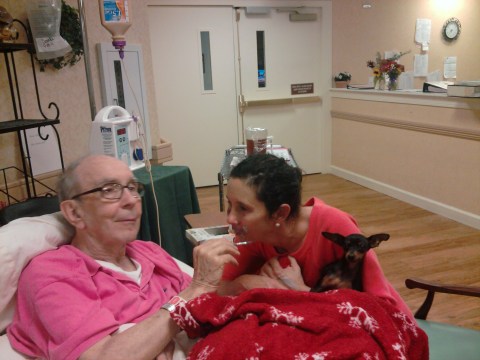
In spite of a severe stroke that left him barely able to speak and unable to swallow, Dr. Bill, as we fondly called him, kept on singing. When I first met him, before he had the stroke, he was always smiling, singing, and joining in the activities at the retirement home where he lived. During one of the art sessions I led there, he also started to recite poetry, the verses of “Trees” by Joyce Kilmer: “I think that I shall never see a poem lovely as a tree.”* One day, shortly after his poetry recitation, I saw that he was no longer at his usual place at the retirement home, and I learned of his stroke. When I came to the hospital, it was a troubling sight: tubes everywhere, Dr. Bill sunken into the bed drained of color and life. But what struck me most were the sounds coming from his mouth. He was still trying to sing. Though most of his faculties had been stripped from him, music, his gift of life, remained.
Later, after he had settled into a new retirement home, I got to know his family, and we talked about how much he loved music and art when he was well. His daughter assured me that they would continue to involve him in both even though it would be much more difficult. His family continued to sing with him, even when the speech therapist had given up. And when painting on paper proved unsuccessful, his daughter bought face paints, and her face became his canvas. In these small gestures was so much meaning. They represented the love that transcends debility. They showed the power of voice and touch to forge connections, even at end of life. And they highlighted the role of creativity in illuminating those connections for all involved.
Dr. Bill passed away on August 30, 2014. His song will ever be with me.
–LC, 2017
*For more, see Shared Doings and Sayings.
Little Star
October 24, 2017 § Leave a comment
 CARMELITA ESTRELLITA and I first met at an adult day center where she and I were serving as volunteers. Her fondness for the elders at the center was evident to me right away, and her kind spirit brightened their faces each time she smiled. At the time, I knew little about this tall, long-haired friend of the elders, only that her gentle presence brought light to their days.
After a while, I stopped seeing her there at the center, and I thought perhaps her schedule had changed. It wasn’t until several months later in fall of 2015, during my volunteer shift at the Hospice House, that I found out the reason for her absence. As I made my rounds, I entered a room to find Carmelita nestled quietly in bed. I learned that after a troubled, and ultimately unsuccessful, course of treatment for esophageal cancer, she had decided to enroll in hospice. At just 60 years old, she had found herself in the final months of her life.
During my shift, we took time to catch up. I gave her some updates on our elder friends at the center, and she told me what had transpired in the months since our last meeting. Soon, however, she began to venture into her past, sharing with me her harrowing life journey, a string of abuses, mental health hospitalizations, and feelings of shame and doubt that arose from being a woman born in a man’s body. She recounted tale after tale of discrimination, of abandonment, of deep suffering. As a child, she bounced in and out of mental institutions, not knowing why or for what end. From an early age, she had longed to live as she felt, as female, but those around her had little tolerance for the transgender person. In her lifetime, she had been without home and family, a stranger to the world and to herself.
But it was her response to the suffering in her life, and to the abbreviation of her days, that rekindled the light in her I had seen so often in the presence of our elder friends. In the place of anger and bitterness, she had found purpose, hope, and love. She found the strength to forgive and the courage to smile. She found gratitude. She found family. She found faith.
In the course of our conversation, Carmelita expressed sadness that so little time remained to share with others her discoveries and the messages of hope woven into the tumult of her life story. On her iPhone, she had recorded a poem she composed called “Book of Mine,” the beginning of a project that she hoped would preserve some of her stories for the benefit of others who, like her, have endured suffering in their lives. She said, “I would like to make a book.”
Her request set in motion the project from which the book Little Star has evolved. Deeply moved by the intensity and honesty of the stories she had shared with me, I offered to work with her to make the book a reality. Having designed a number of books in the past, I was very excited to collaborate with her on this—and I was humbled to take on the task of collecting and representing her words (and artwork) in this way.
Over the course of a few months, we met almost weekly in her room at the Hospice House to record her stories and to make art together. Carmelita has loved to write all of her life, and she studied painting in New York and at the University of Virginia. So with art supplies generously given to her by her friends, she put pen to paper and brush to canvas, rendering scenes that are a mix of memory and imagination, as she talked to me about her experiences. We recorded the conversations with her iPhone, which I later transcribed for publication in the book. While she spoke, I also took the opportunity to draw her, as a portrait artist is eager to do, and I have included these sketches in the collection of memories that the book contains.
In the months of our collaboration, I could see the blessings that had inspired the messages Carmelita wished to share with the world. In stark contrast to the abandonment she had experienced early in her life, a steady stream of friends and family ebbed in and out of her hospice room, sometimes carrying her out to her favorite places around Charlottesville, other times releasing surges of tears and laughter as they mended old wounds or remembered times of joy. From her bed, she was even able to stay connected to the elder community with which she had formed such a strong bond. She continued to show her support for a local initiative called Friends of Elders, a group of volunteers dedicated to eliminating loneliness, isolation, and abuse of older adults in the community. And in the midst of the turmoil she endured in the months following her diagnosis, she had even found the love of her life, a friend who stood by her side through it all. What she had longed for in all those years of suffering seemed to blossom in this last chapter of her story.
But I also could see the fears and the distress that naturally attends confrontation with one’s mortality. She had nightmares and sensations of immanent death. She described the ways in which her body was beginning to lag behind her conviction to be and to love in the world. She lamented the impending loss of the relationships that had enriched her life so deeply in the past few years. Thus, entwined in her messages of love and forgiveness are inevitable insecurities that death cannot but evoke in us all. But she did find some solace in her friendships and her faith in God. She found hope, too, in the sense of purpose that our project had given her.
Carmelita impressed upon me that she would like her messages to reach others who face struggles in their own lives. She said, “I think I’m already making this book by the people I’ve talked to and the people that come in here—it’s had a good effect on people.” From my point of view, I see this is true, and Little Star is yet another way to spread the seeds of goodness she has sown so far. It is a snapshot of her indomitable spirit, a little star whose light will shine when that of her body has faded.
One of the most moving accounts contained in this book is the story of the bond that Carmelita formed with her aunt at end of her life through a shared interest in literature. She called their time together “a blessing for both of us.” I feel the same way about the time I have spent with Carmelita. She has opened my eyes to dimensions of suffering I had never understood and to the capacity of the spirit to find beauty in it nevertheless. She showed me the power of forgiveness, which the pages of her book have the potential to awaken in all of us.
–LC, 2017
For more information about Little Star and to order a copy of the book, please email Lauren Catlett at lec2c@virginia.edu.
The One I Called Mother
August 12, 2016 § Leave a comment
I look a lot like the woman in the portrait above my bed. Dark hair, slender build, sloping nose that cantilevers over parted lips and square teeth: our features are architectural. She sits erect in a sequined wedding gown, beaming with the joy of a new bride. My eyes seek hers, but she evades them, her gaze fixed on some faraway place.
What is her story? I know that by thirty-four years old, she had married and become a mother of two girls, and I know she designed the house that her family now inhabits. I know she was an artist, filling sketchbooks with delicate pencil drawings, from which her daughter spent many childhood hours copying. I know that she thirsted for perfection, no smudge un-scrubbed, no wrinkle unsmoothed. And I know that just five years after she sat for that portrait, she lost her life to a mysterious illness.
No one knows when her symptoms first appeared. Only when intractable fever, rash, and pain gained her admission to the hospital was it clear that illness had cracked her stoic façade. “Her muscles and joints are hurting her, and they hope to find out why,” her mother wrote at the time. “I’m getting very worried.” But her doctors were at a loss for a diagnosis. They suspected Still’s disease, a rare inflammatory disorder. She was prescribed steroids, and she began to recover, returning home a week later.
Recovery was, however, illusory. One night, a month after she left the hospital, she awakened her husband in a fit of breathlessness. A cough that caused no alarm the day before had progressed quickly to severe respiratory distress requiring admission to intensive care and emergent intubation. Fluid seeped into her lungs. Her immune system was failing, and she was suffocating.
Imagining myself at her bedside, I picture a woman very different from the one in the portrait. A halo of tubes and wires radiates from her slender body, loosely veiled in a wrinkled hospital gown. Her lips turn to blue, starved of the breath that passed through them just hours before. Her eyes are closed, her expectant gaze extinguished, and her frame, once so strong, collapses into the tangle of sheets, tubing, and frantic fingertips desperate to save the life obstinately slipping through them. She languishes in chaotic silence as the final beat of her heart strikes her breast and the first tear falls for a spirit too soon departed.
My thoughts turn to her young children. I envision them crawling curiously through an ever thickening forest of dressed-up legs belonging to people familiar and strange whose whispers like wind and tears like rain descend upon their heads as the tempest of loss sets in. I hear their lonesome cries echoing from the walls of the house she built. I marvel at the accomplishment of that house, whose structural integrity defiantly outlasted that of its designer. It would shelter those children in her absence, a womb of beams, bricks, and grit. The labor was long, and the girls were born into adulthood unsmoothed by their mother’s touch.
A mother’s death shapes her daughter’s life. It carves a hole at her core that she spends every day trying to close. She patches it with stoicism and indifference, eschewing the pain in silence. With time, the patches disintegrate, and the wound reopens, scarred but spilling sorrow just as fervently as the day it appeared. She carries on quietly, lips tightened to contain the grief circulating out of her fenestrated heart. She becomes an edifice. Guarded and mute, she nurses her wound alone, fearful that exposure to the elements of judgment and pity would widen it. She thinks the cracked foundation is a structural flaw only her mother’s hand can repair.
She flips through her mother’s sketchbook and pauses on the pages where delicate pencil lines articulate hands with long fingers poised in gentle gestures. She traces those fingers with her own, noticing how alike they are. She picks up a pencil to draw, and she tries to resurrect her mother’s hands with her clumsy scribbles. With time her artistry improves, but years of practice never allow her to grasp her mother’s spirit trapped in the fibers and fabric of parchment and time.
Her hand, empty of a mother’s touch, grows cold, and she extends it to the others in this world that illness and adversity have emptied. It is an act of charity steeped in self-interest, for she hopes that holding their hands will break the numbness in hers. She takes hold, knowing that the union could close the wound her mother’s death had created—or inflame it. She takes the risk, driven to feel, and heal, the heartache of her loss.
My thoughts return to the portrait on the wall of my room. I nod to her, the one I had called mother—before she took her last breath, 25 years ago today.
—LC, 2016

Like an Arrow
March 21, 2015 § Leave a comment
My mother was three years old when she first met Mrs. Kagawa. Twenty years would pass before she met her again. My father was with her then. Mrs. Kagawa played this instrument, the Shamisen, and sang them a song. When she finished, my father asked her, “Mrs. Kagawa…That song you played…what do the words mean?” She told them:
Time flies like an arrow young people, so be careful what you do with your time.
Six decades have passed since my mother first met this sage Lady, but her wisdom has remained with my parents and with me. I reflected on her words one fall morning with my mother and father just before returning to medical school after a short break. I was filled with gratitude for the generosity my dad showed in waking to see me off. We hugged goodbye, I remember, and he slowly walked back to his room to rest.
Mrs. Kagawa’s words returned to me a few weeks later as I shared the following dedication during the annual ceremony to honor our anatomical donors at the UVA School of Medicine:
Standing here, together, on this hallowed ground, we honor the good women and men who gave their physical bodies for our education. They gave this gift, their final gift to us and our future patients, people they never met.
In this cynical time in which we live, it is essential to pause, to find silence to reflect on this generosity. If some say true altruism does not exist, we must ask, does their gift not prove that it does?
The donors we honor taught us anatomy, they remind us of our own vulnerability and mortality, they show us what selflessness is.
With a flicker we come into this world, for a time we are strong, and then we grow old and we pass just as quickly and mysteriously as our arrival.
As we reflect on what these great women and men gave during their lives and offered us with their last gift—we must ask, what will we do with our lives, what will we give to society. How will we pay forward what we have been given? As Mrs. Kagawa told my mother when she was most strong and able,
“Time flies like an arrow young people, so be careful what you do with your time.”
—Thomas Ball, 2013
Thomas Ball is a University of Virginia medical student. This reflection honors his father, who died six months after the morning described, one year ago today.
—LC
Cooper: A Soloist
January 17, 2015 § Leave a comment
His diagnosis came with days to live. An abdominal mass was compressing his vital organs. It was inoperable. Go home, and wait, we were told. As I stood in the halls of the hospital holding his swollen body in my arms, tears blinding me, I wondered how much time I had left with my little one.
In his twelve years, he had filled our lives with boundless energy and joy. His sharp and stubborn intelligence was rivaled only by his love for those around him. His bright eyes warmed our spirits, and his distinctive voice sheltered us from loneliness. He loved to sing: every day his falsetto reverberated within the walls of our house—and our hearts.
As he hovered at the cusp of life and death, we stayed close to him day and night, cloaking him in caresses and prayers. We waited, as prescribed. And every evening we expected the night to claim our boy.
Many nights passed. In fact, many months passed before his life came to a close at this time last year. Whether through love or lust for life, he persisted with dignity and strength. Never did he utter a complaint, and the only cry he made was in song. The fortitude he showed in those last months was formidable in one so small.
His tenacity was a revelation. Full of life’s music, his voice knew no reservations—until the confrontation with illness led him into courageous silence. Wordlessly, he taught me how to speak up and when to hold my tongue. He reminded me that from even the smallest boxes come the strongest voices.
I was not with him when he died. I wonder if I should have been there, but I suspect that my presence would only have prolonged his life. Like my grandmother, Estelle, I believe he surpassed his grim prognosis out of a sense of responsibility for his family. A singer lives for his audience. But unlike my grandmother, I believe he wished to perform his last song in solitude.
Cooper, with your music we were never alone. This song is for you.
— LC, 2015
The Song of Her Life
September 26, 2013 § Leave a comment
I saw the car speed into the yard while perched on top of the ruins. From my vantage point, I could see a cluster of people carrying an elderly woman into the hospital. I was concerned and curious, but given the urgency with which the people were carrying the woman, I decided that I would stay on top of the ruins for awhile until things calmed down.

Hospital, Leogane, Haiti © 2011 Mike Taylor
It was 2011, and I had been sent to post-earthquake Haiti to examine the still-colossal rubble situation. This was my first solo excursion in a developing country, one that was soon to be cut short by an improbable bout of malaria. At this moment, though, I had sought some solitude at the top of the collapsed concrete and steel hospital where I had made my base of operations. As the noonday sun reached its peak, it became much too hot for me to remain on the roof. I decided to try to get back to my little room while causing as little of a disturbance as possible.
What I saw inside was not encouraging. The woman was unconscious and looked to be about 80 years old, if not older. The majority of her family was gathered around her bed, and Dr. Jo was kneeling at the headboard to listen to her chest. My number one concern while in Haiti was to make sure that I did not impede the normal functions of the hospital, so I crept into my room and closed the door. I stayed there nervously for several hours, passing the time by reading Neil Gaiman’s Fragile Things.
Eventually I heard a knock at my door, and to my surprise, it was the doctor himself who had come to visit me.
He asked me, “Did you see this woman?”
“Yes, I did. Is she ok?” I immediately realized what a dumb question that was.
“No…she is not doing well. She has what I think is pneumonia, and we have medicine, but without knowing what is wrong with her, I cannot know what medicine to give her or how much. I may guess, but I need instruments and tools that this hospital does not have yet. This is, as you know, very far from the city.”
“Can you move her to somewhere else where she can get care?”
“No…she is not stable enough to move anymore…I will do what I can, but I am afraid that she will die. I wished to let you know now, so that you too are prepared for what you might see.”
I stayed in my room for the rest of the afternoon, occasionally peeking out to see if anyone had left. In the early evening, after Bernard had brought me another meal that was too large for me to eat, the singing started. I have struggled many times to put anything into writing which could describe what I heard through my closed door, but it always falls short. Suffice to say, it was beautiful. While I couldn’t understand any of the words, I felt like her family was singing her the song of her life in those last minutes as it drew to a close. When the singing finally faded away that night, I looked outside my door to find that the bed was empty.
It has been nearly two years since that afternoon, and I still feel conflicted about committing this story to paper. At the time, I did not quite know what to feel, except for a sensation of guilt in having witnessed something immensely private and profound. That feeling has persisted, but I hope that by finally sharing this story, I can do some small honor to the memory of the woman I never met.
I have to imagine the details of what went on beyond my door, but I believe there was grace and closure in her passing. The world is harsh, certainly harsher in some places than others, and there are many emotions with which one may approach death. I do not believe this woman or her family had fear, or anger, or confusion. In her decades, I cannot doubt that she overcame more adversity than most of us have ever known, but the sadness and pain of those moments were surely accompanied by the joy and love and gratitude of the family she raised around her. Now, as her family sang to her, she accepted her well-deserved rest. I can only hope that when it is my time, whenever that may be, that I can pass on as gracefully as her.
Some Haitians have a way of looking at time that is very different than we do. As I struggle to bring this to a close, I find myself thinking back to my first day in Haiti when everything in that country was new to me. My eyes kept flickering between my watch and the dusty road while I shuffled my feet and waited for a car that was already forty minutes late.
“What time do you think our ride will be here?” I asked my Haitian friend, trying not to sound impatient.
My friend grinned, and told me simply “I do not know, but I will give you your answer as soon as it arrives, and no sooner than that.”
— Mike Taylor, 2013
Mike Taylor is a researcher at Carnegie Mellon University currently pursuing a PhD in Robotics. He first traveled to Haiti in 2011 to study the energy infrastructure and rubble situation in Leogane after the 2010 earthquake. Mike documents his work and travels through photographs, such as the image above and this panoramic view of Port-au-Prince.
— LC
A Lesson on Personhood
August 27, 2013 § Leave a comment
“Recently, I was sitting with a dying patient who was in pain and short of breath. I said, “I can see you are suffering.” He replied, “I’m not a person anymore. I can’t walk outside; I can’t play the piano. I’m just not a person. My time is up.” This exchange recorded in the essay “Narrative Possibilities: Using Mindfulness in Clinical Practice” by Julie Connelly, MD, author of the most recent post to this site, raises an urgent yet fundamentally unanswerable question: does the death of personhood precede death of the person? In his fragile physical state, moving toward death while immobilized on his deathbed, the man believed he had witnessed the interment of his personhood even as his body lived. Reading this exchange for the first time left me dismayed. That he no longer identified as a person because of his physical limitations was admission that level of ability relative to one’s past corresponds to one’s very existence as a person, and consequently, that disability means diminished personhood. While I will leave ontological argumentation to the philosophers in this case, personal experience gives me reason and license, presumably, to comment on the matter. Working each day with older adults who, because of illness or frailty, are no longer able to engage in activities that once defined them, I see that, while certain abilities have been lost, their personhood remains intact. I see their creativity emerge as they find new ways to interact in a world that ill health has made alien to them. An artist paints with her left hand when her right is crippled; a professor of literature invents a kind of sign language when words begin to escape her; a dancer taps her toes to the sound of music when weak limbs have left her all but in a wheelchair. Even days from death, an opera enthusiast enjoys one last show with a friend, watching scenes unfold on screen across from her hospital bed. These encounters reveal personhood bright and clear, where diminished faculties of mind and body have inspired adaptation, not evacuation, of identity. Personhood is more than ability, and the dying person continues to have access to personhood as long as it has modes of expression beyond those that it once had in the past—and these are infinite.
While I do not mean to extrapolate the dying man’s words as a general statement on the nature of personhood at the end of life, I do believe the implications that his words evoke must be challenged if we are to exit the dangerous territory in which dis/ability solely defines identity. Yet a second reading of his confession raises a different interpretation. “My time is up,” he concluded, casting his resignation of personhood in a new light. While his words may reveal the nature and degree of his suffering—his perceived distance from a former identity—his final statement suggests acceptance of his mortality. Perhaps, in some ways, resigning one’s personhood becomes a way to relinquish ties to identity as a living person and enter into the identity of one who is dying. For some, this subtle change in perception may be the key to a peaceful death. Perhaps the death of personhood must precede death of the person in some cases to ease or even enact the transition from life to death.
Much more can be understood from the man’s words, especially in the full context of his final days as described in Connelly’s essay, but for now those musings will remain unwritten. Nevertheless, this brief exchange between a patient and his doctor aroused in me both conflict and new insight. While it represents a seemingly fatalistic outlook on personhood at the end of life that need not, and indeed should not, apply to all dying persons, it does describe a mode of experiencing the dying process that may in fact help release ties that fundamentally resist the transition. For those of us whose time is not yet up, Connelly’s account calls on us to meet the dying person where he is—to abandon preconceptions of what is “best” for him (oh, how I would have liked to show him how much of his personhood remained to him without the ability to walk outdoors or play piano!) and to support his personhood or to accept his denial of it, as relationship and circumstance see fit. Personhood may indeed die before the person, but it is not inevitable—and it may yet never die at all. But that is for another post.
— LC, 2013
A Lesson on Luck and Blessing
June 30, 2013 § Leave a comment
Narrative knowledge allows and encourages human connections.
— Julie Connelly, “In the Absence of Narrative,” 2002
I learned a very important lesson one afternoon last summer. At the time, I was medical director of the local hospice, a part-time position that required visits to patients in their homes. Most of the visits were scheduled, but sometimes situations changed, emergencies happened, and I was needed right away.
That day, the nurse called me at home where I was writing. It was an afternoon that I had looked forward to as a time to get some of my own work completed. She told me that last week an elderly man was visited at his home by his family—a usual weekly visit. He seemed to be doing well enough, but today their visit was different. He was in distress. They called for help and all reports suggested that he was dying; the nurse needed me to go see him right away.
I arrived at his home after a 40-minute drive. In the yard where I parked, I was met by a hospice nurse, the patient’s granddaughter, and his daughter. We talked outside for a few minutes, where they described their concerns and the changes in his condition that had occurred in the last week, and then we went in the house to see him.
The white frame house was surrounded by an unfenced yard, lilac bushes were in bloom, and a yellow and white cat ran across the back door. Inside, we entered a porch, then moved into a large dark room where books and magazines were piled high, boxes of collected belongings filled the space, and clothes were neatly folded in an overstuffed chair. In one corner of the room was a double bed where a very frail 94-year-old man was lying on his back, his eyes sunken deep, and his head propped up on several pillows. He was totally alert and present to all of us entering the room. He looked at me and said, “I know you, yep, you took care of my wife when she was at the nursing home.” I didn’t recognize him at first, but then I began to remember his wife, her illness and death several years before at the nursing home.
As we talked, he told me that he had been nauseated and unable to drink anything for the last five days. He said that his “belly” hurt, and he wanted a shot so it would stop hurting; he also said, “I really want some lemonade. I’m so thirsty.” When I asked him about his medical history, he said, “I’ve never been sick before. I’ve never been to a doctor, never to the hospital, and I don’t take any medicines.” This was so remarkable for a 94-year-old—no history of being ill at all. I was amazed. Happily I said to him, “Wow, you are a lucky man!” I was sitting next to him on his bed. He stopped and looked straight into my eyes with an incredible intensity. He said, “I’m not lucky, I’m blessed.”
For a while after the nurses got him settled in a clean bed, he sipped cool lemonade, the only remedy he desired for his thirst. Then he rested his head back on the pillow as a smile appeared. He closed his eyes. Later that night he died.
— Julie Connelly, MD, 2013
Julie Connelly is an internal medicine physician, photographer, and writer who explores the value of narrative for medical professionals through her pictures, essays, and stories. She is the author of an essay entitled “In the Absence of Narrative,” in the collection Stories Matter: The Role of Narrative in Medical Ethics (ed. Rita Charon and Martha Montello), in which she makes the case for creative reflection in improving physician-patient relationships and empathic medical care. Though luck, whether good or bad, may bring physician and patient together, Connelly demonstrates in this and other narratives how the lessons of physician-patient encounters at the end of life may reveal themselves as simple, yet powerful, blessings.
— LC
 STELLA